Two new videos of the pups!

June 29th, 2011
Here is a video of our giant anteater, Eury, enjoying a gorgeous day on exhibit with our maned wolf family.
June 26th, 2011
The Maned Wolf Family blog has had over 11,500 pageviews from 37 different countries! Also, the Maned Wolf SSP® has recommended that Bonita and Chiquita both travel to the Beardsley Zoo in Bridgeport, Connecticut to live together in their exhibit. The sisters won't be leaving us until November or December, when they will be old enough to leave mom, dad, and Vinny. As of now, Vinny will remain with us until a mate or exhibit opening becomes available at another facility. With Bonita and Chiquita moving together, they will keep each other company and help each other adjust to their new home. It is natural for maned wolf pups to leave mom and dad; maned wolves don't form packs like some of their cousins do. Connecticut may be a little cooler than North Carolina, but the girls are already used to going into and out of a building, so they will do great! Check back this week for a very cute video of Eury, the giant anteater! The maned wolf family and giant anteater are getting along fantastically in the exhibit.


June 16th, 2011
The pups' titer levels came back from the lab. Their antibody levels were great for parvovirus, but a tad low for distemper. Today, we gave them an extra booster shot for distemper; they should now be all set until their 6 month check-up.

Bonita
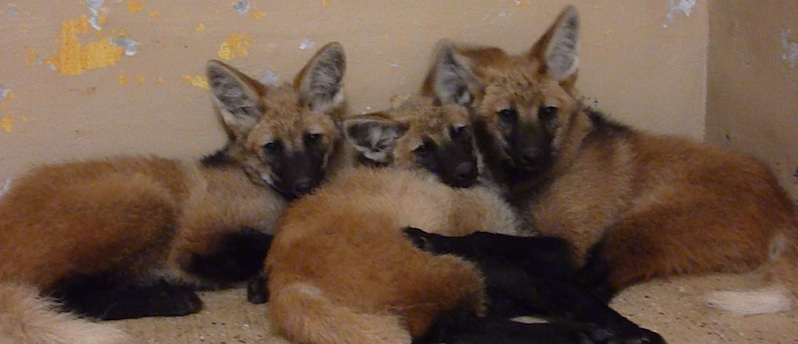
Chiquita is on the left, Bonita in the center, and Vinny on the right.
May 29th, 2011
The maned wolf family and the giant anteater, Eury, are getting along great in the exhibit. The pups are more and more curious than afraid of Eury every day. Lana and Nazca are realizing that he isn't a threat to the pups.


May 25th, 2011
The pups had a visit from the veterinarian today for vaccinations, blood-work, and a general health check-up. They were boostered for distemper and parvo viruses and received their first rabies vaccination. Blood was drawn to check general health and also to check titer levels on the results of the vaccinations they've been given. An antibody titer test measures the amount of antibodies present in the bloodstream. Antibodies form in response to vaccinations and/or from exposure to the antigens representing an actual infection with a virus. The pups can also begin storing up antibodies from their mother. The more antibodies present against a particular antigen, the more protection the pups should have against becoming infected and sick from those antigens in the future. Titer levels change over time and can help us to decide how often the pups will need booster vaccinations. The vaccinations that we use on the maned wolves, as with any non-domestic animals, were only developed for/are only FDA approved for particular domestic animals. This is because it takes time and money to go through the FDA testing/approval process and there aren't enough non-domestic animals kept in captivity to warrant the resources. However, by checking titer levels, we can check to make sure that the vaccinations are effective in our animals. We will evaluate the antibody titer test results when they are completed in a couple of weeks.
The pups are in good health and were started on monthly flea/worm/heartworm protection. The pups weighed between 16 and 18 pounds. Like the adults, they weigh much less than you would think for their size. Their long legs and slender build are very different from that of a german shepherd or a grey wolf.


The pups are in good health and were started on monthly flea/worm/heartworm protection. The pups weighed between 16 and 18 pounds. Like the adults, they weigh much less than you would think for their size. Their long legs and slender build are very different from that of a german shepherd or a grey wolf.


May 14th, 2011
This past Wednesday, we introduced the giant anteater, Eury, into the exhibit with the maned wolf family. Before the pups were born, Eury lived with the wolves on exhibit in cooperative weather. The adult wolves would usually move out of the anteater's way when he would walk around the exhibit and the anteater would ignore the wolves. We expected that the adult wolves would behave differently now that they had pups to protect. We had introduced the anteater to the pups through a fence when they were much younger, but the anteater has been out of the exhibit area for more than a month now. Before introducing Eury back into the exhibit, we waited until we felt that the pups were old enough to move out of the anteater's way. Wednesday morning, after a couple of days of fence-contact, relevant staff gathered at the exhibit and preparations were made for the introduction. We weren't expecting anything awful to happen to any of the animals, but we were prepared to separate them again if needed and our veterinarian was on call. When Eury entered the exhibit, the adults didn't get nervous until he neared the pups and/or the main outside den box. The adults did display protective behaviors, but staff was confident that the introduction would continue to go smoothly and that the animals would become acclimated to the situation over time. Because Eury hadn't been on exhibit for quite some time, he was more active than usual and confrontations between himself and the adults occurred fairly often throughout the day. Mid-afternoon, the decision was made to bring Eury out of the exhibit to give all the animals a break from the stress. The pups don't really understand what Eury is and would run to the opposite side of the exhibit when he approached. On Thursday, we again let Eury into the exhibit. All the animals were much more calm than the day before. Today, the adults were much less concerned about Eury being a threat to the pups and the pups were beginning to accept his presence. We will continue to put Eury in with the wolves a little bit each day, with staff watching, until all the animals seem comfortable with the mix. When you visit us, you may now see Eury on exhibit or with access to the side holding yard. This introduction is important for the future of captive maned wolf conservation efforts as successful mixed-species exhibits may inspire more participation from zoos and conservation centers. Not only is this mixed-species exhibit more natural and enriching for the animals, but it is more educational and interesting to zoo visitors. Maned wolves and giant anteaters share native home ranges. Wild maned wolf pups would encounter many challenges and creatures; our pups live in a safe environment that also includes many natural components.
May 6th, 2011
This is more footage of Nazca regurgitating food for the pups. They are eating solid food with their parents, but are still eating regurgitating food because, in the wild, the only source of food they might have is the food that their parents bring back from hunting trips. We have only seen Nazca regurgitate food for the pups. The pups may occasionally continue to nurse for the next month, but should stop at about four months old. The pups have been very active this week and the exhibit grass has been clipped down for better viewing. They also received another round of vaccinations this past Thursday. Bonita weighs 14.3 pounds, Chiquita weighs 13.9 pounds, and Vinny weighs 12.8 pounds. Bonita is still the calmest of the group.
May 1st, 2011

Chiquita
Lana and Nazca were inspired by the pups!
April 26th, 2011
Check out the latest video of the pups! The grass is getting very tall in their exhibit; the pups love this! When we have the opportunity (when the pups are indoors), we will selectively trim the grass down for better viewing.
April 23rd, 2011
As National Volunteer Week draws to a close, I just want to say "Thanks!" to all our zoo docents who have helped us keep our maned wolf exhibit quiet and safe for our precious pups and their amazing parents! We wouldn't be able to have the exhibit open without the donation of their time. Having the exhibit open is not only great for visitors and maned wolf conservation efforts, but it also helps the pups get used to the sights and sounds that may be a part of their future homes. You can read about some of our zoo docents on a blog done by Trent Hazzard, a NSC volunteer and part-time staff member: http://nscofg.blogspot.com/2011/04/volunteer-spotlight-hayes-barber-and.html
April 22nd, 2011
Every day should be an Earth Day; small things can make a big difference! Celebrate the Earth this month by taking a few extra steps towards making your daily practices Earth-friendly. Not only will you be helping out amazing creatures such as maned wolves, but you'll also be helping to give yourself and future generations a healthier place to live.
April 21st, 2011
Chiquita and Bonita weigh 10.6 pounds! Vinny weighs 9.9 pounds.
On Sunday, a docent (zoo volunteer) observed one of the pups catch and eat a skink in the exhibit, so today, we offered the pups pieces of mice. The girls were a little unsure, but Vinny gobbled the mice up right away and looked for more! Bonita has the gentlest personality, while Chiquita is very sassy. Vinny's personality is hard to read, but we think he is very much like his dad. They will be 11 weeks old this Sunday.
On Sunday, a docent (zoo volunteer) observed one of the pups catch and eat a skink in the exhibit, so today, we offered the pups pieces of mice. The girls were a little unsure, but Vinny gobbled the mice up right away and looked for more! Bonita has the gentlest personality, while Chiquita is very sassy. Vinny's personality is hard to read, but we think he is very much like his dad. They will be 11 weeks old this Sunday.

Bonita getting weighed
April 15th, 2011
The pups had their second round of vaccinations yesterday. They are all about 9.5 pounds. It took us quite awhile to find the pups hiding in the grass! They are all experts at camouflage, which would be very helpful in the wild to help them hide from predators. As soon as they perceive possible danger, they all hide in separate spots that are perfect for their purpose. The award definitely goes to "Bonita" though. We walked right by her 4 or 5 times before we actually spotted her! If you visit the pups, please remember to hold on tight to any loose objects that you may be holding. We have had several objects fall into the exhibit this week, including a couple of shoes. If the pups get and ingest these objects, they may be injured or become sick. We are unable to go into the exhibit very often to retrieve the objects, as mom and dad are being very protective of the pups. Please help us to keep them safe!


Bonita is very calm while we weigh her! Her head looks so big compared to her body.


Bonita is hiding from mom!

Peek-a-boo!

April 14th, 2011
Here is the latest YouTube video of the pups and some interesting photos!
The first four photos are courtesy of Betty Barry, one of our docents and board members. Thanks!

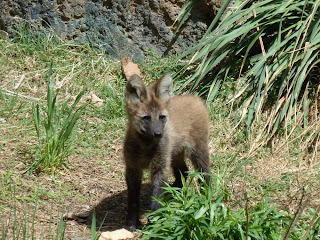


The first four photos are courtesy of Betty Barry, one of our docents and board members. Thanks!


Vinny spending time with mom!


Bonita has found something interesting!


Dad is doing a fantastic job! He has been observed regurgitating for the pups!

I haven't had anything to post for a few days, but I took some very cute photos and videos of the growing pups this evening that I will get up online tomorrow. Thanks for your patience! The pups are doing great. We will attempt to give them their second round of vaccinations tomorrow, but it will be much more difficult now that they are so mobile and spunky!
Subscribe to:
Posts (Atom)